 Es PosibleEs Posible
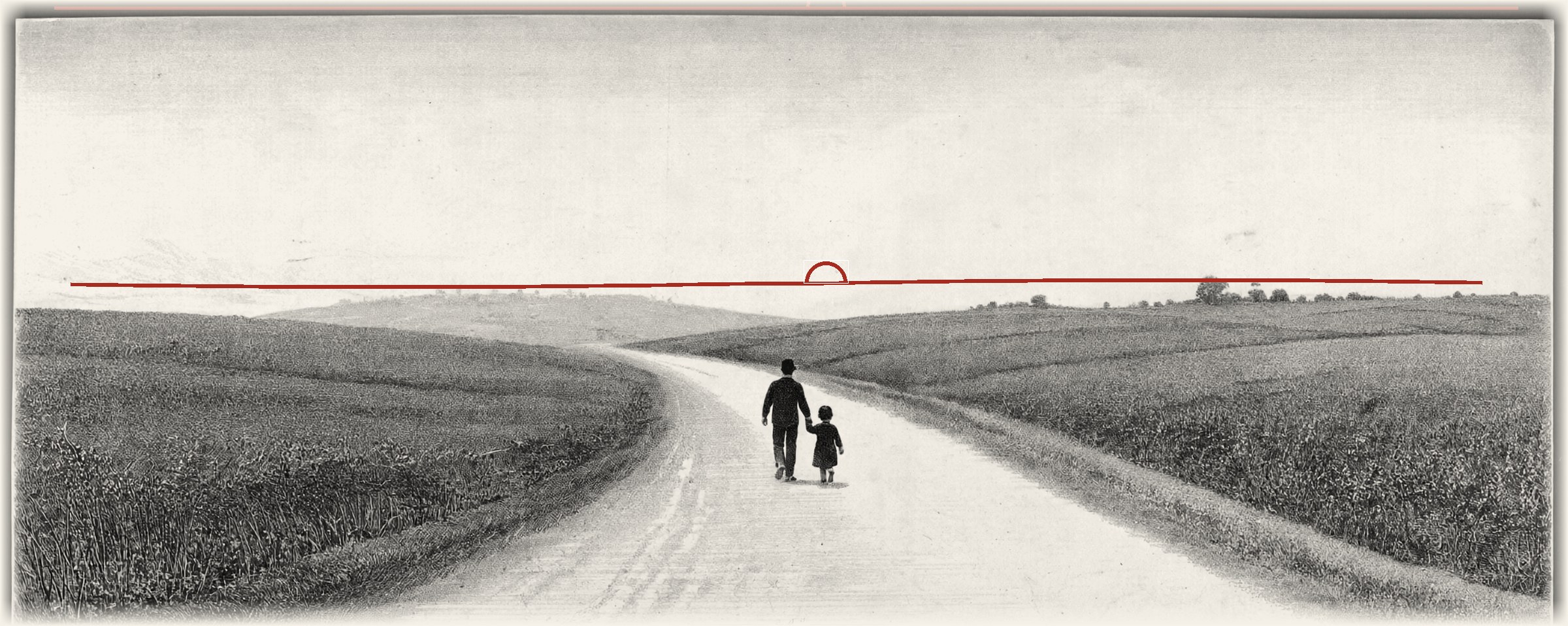
The darkest hour of the day is the one before dawn
The darkest hour of the day is not midnight. It is the one that comes right before dawn.
I write from the other side of that hour. Not from a clinic, not from theory: from the man who had it on top of him and crossed.
This essay is for you, the one who is inside it right now. You do not have to believe me yet. You only have to finish reading.
The lowest temperature and the deepest darkness of the day come an instant before sunrise. That is not a metaphor: it is meteorology. See for yourself.
Anyone who has spent a whole night outdoors knows it: the cruelest cold does not come at midnight. It comes at the end, when there is almost no night left to endure. The sky turns blacker, the body shakes harder, and right then, without warning, the first line of light breaks.
Depression works the same way. The worst moment is usually closer to the exit than to the entrance. But from inside you cannot see that, because inside there is no clock.
I am not writing this from a self-help book or from the theory of someone who studied depression in other people. I write from inside, from the man who one morning could not get up and could not explain why. And I write now that I have crossed, because from the other side you can see what is invisible from within: there was a way out. There always was. The dark room had a door, and I was sitting on it.
The cruelest lie about depression is calling it sadness.
Sadness is a luxury compared to this. Sadness has an object: you are sad about something, about someone, about a loss with a name. Depression has no object. It is an anesthesia. It is waking up and having the whole day weigh on you like a wet coat. It is the people you love talking to you, and you hearing them from the bottom of a pool. You do not want to die: you want to stop being tired of being alive, which is different, and nobody explains that to you.
And it has an anatomy — that is why this essay bears the name. It has bones: the 3 a.m. insomnia, or the twelve-hour sleep that does not rest. It has muscles: the clenched jaw, the stone shoulders, the occupied chest. It has blood: that circular thought running through the same veins, always the same one, always at the same hour.
And it has a voice. The voice is the worst part. It speaks in your own accent, uses your own memories, and tells you this is what you are, that it was always like this, that it will always be like this.
That voice lies. I know because I believed it for a long time. And I know because one day it stopped talking.
No one who controls your mood governs you. No one.Anatomy of Pain · Simón Levy
Now I want to tell you something almost nobody says about depression, and it is the reason why I, a man who studies power for a living, had to write this.
Your mood is political territory. The last territory. They can take your money, your job, your country, your name. But the day they take your spirit, they no longer need to take anything else, because you hand over the rest yourself.
Think about it coldly. A depressed man does not fight. He does not demand, does not ask, does not organize, does not build. A depressed man manages his survival and is grateful to be left alone. And a depressed society is the dream of every power: millions of people convinced that nothing can change, that nothing matters, that the energy barely covers getting to the night.
That is why fear is state policy in so many places. That is why outrage is administered in daily doses through a screen: enough to exhaust you, never enough to move you. That is why there are entire regimes whose main product is not oil or steel. It is discouragement. They manufacture tired citizens, because tiredness obeys.
So understand this, and understand it as an act of war: every morning you get up, you are disobeying. Getting out of depression is not only a health matter. It is recovering the sovereignty of your own inner territory.
That idea carried me through entire days. Not joy — I did not have it. Defiance.
I was raised to control. To plan, to foresee, to manage risk, to always have a map. And depression laughs at maps, because depression is precisely the territory where your strength does not reach.
I came to God the way a man comes who has already tried everything else. Not through doctrine. I arrived on my knees, which is the only door that house has. And what I found was not an instant miracle or a light on the ceiling. I found something more useful: a place to set down what I could not carry.
Because that is the exact mechanics, and I give it to you without ornament: depression feeds on impossible control. On trying to solve today what cannot be solved today. On carrying the entire past and the entire future in one head, every night. And prayer, in its barest form, is an act of logistics: it is moving weight. It is saying, with words or without them: this, I no longer carry.
I am not asking you to believe what I believe. I am asking you to understand the principle: nobody leaves depression with closed fists. You leave with open hands. Letting go. What for me was God, set it down wherever you can set it down. But set it down.
Depression convinces you that the problem is in your head, and that therefore the solution is in your head: think better, understand more, find the idea that sets you free. It is a perfect trap, because it sends you to fight exactly on the ground where it is strongest.
The body is the other front. The one it does not rule.
The head can lie to you for hours. The body does not know how to lie. When you walk, you walk. When you sweat, you sweat. When your heart rate climbs, it climbs, whatever the voice thinks. And something happens — I say it because I lived it hundreds of mornings: at some kilometer, without warning, the voice turns down. It does not go silent. It turns down. And in that margin of silence fits one thought of your own, truly your own, the first of the day.
Sport did not cure me. Sport gave me, every day, forty minutes of liberated territory. And wars are won like that: one territory at a time.
We are going to buy him the food, Dad.My son, on an ordinary sidewalk
One afternoon I was out walking with my young son when a man asked us for two dollars.
I did what adults who think they know better do: I offered him food instead of money. It is the prudent answer, the answer of someone who has learned to distrust. The man accepted, and my son said at once: let us go buy him the food, Dad.
But the restaurant was a few blocks away, it was late, I was tired, and at some point along the way I started looking for the exit. I was about to turn around when my son looked up at me and said the sentence that disarmed me:
Dad, you would only buy this man food if someone were watching you. But we are going to buy the food.
Seven words from a child, and inside them a complete X-ray. He was right. We adults have turned kindness into a transaction with an audience: we help when there are witnesses, we post when we help, and when nobody is watching we negotiate our retreat with ourselves. My son has not learned that yet. For him, a word given to a hungry man was a debt that had to be paid, audience or no audience.
We went. We bought the food. We delivered it. And the one who left that sidewalk fed was me.
I tell this here, in the middle of an essay on depression, because that afternoon I understood something no book had given me. Willpower is not a solitary muscle: sometimes it is borrowed. That day I walked the blocks I did not want to walk holding the will of a child by the hand. And that is also how you leave depression: on the borrowed will of the people who love you, while yours comes back.
And I understood the second thing: the oldest antidepressant in the world is being useful to someone else. Depression locks you in the only room that has no exit, which is yourself. Doing good without witnesses is the back door. Nobody applauds you, and that is exactly why it works: for a moment you stopped being the center of your own pain.
Whoever is inside does not need literature. They need instructions. These are mine — the ones that worked.
First: consistency. Not heroism. Depression is not defeated in one great day: it is defeated across two hundred mediocre ones. Do not wait to feel like it, because the feeling does not come first. Motivation is a result, not a requirement. Do the thing without the feeling. Doing it without the feeling counts double.
Second: let go of control. What you cannot solve today does not get solved today. Repeat it like a hammer. The depressed mind wants to judge your entire life every night in a single courtroom. Dissolve the court. Today, only today is on trial.
Third: walk every day without expecting a precise destination. This one cost me the most. I wanted to know when: when it ends, when I get to be me again, when dawn comes. And the question itself was sinking me, because every day without an answer felt like a failure. Until I stopped walking toward a date and simply walked. The road does not promise you an arrival day. It promises something better: no step is wasted. One day you look back and the dark room is far away, and you do not know on which exact step you got out, because it was not one step. It was all of them.
And a fourth that is not mine but is true: asking for help is also walking. Talk to someone — a doctor, a therapist, someone who knows. I, who speak to you of God and of sweat, tell you this too: the brave ask for help. The ones who give up are the ones who do not.
And now the sentence. The one everyone knows and almost no one knows where it comes from.
God, grant me the serenity to accept the things I cannot change, courage to change the things I can, and wisdom to know the difference.
Half the world attributes it to St. Francis of Assisi. It is a beautiful mistake, but a mistake. St. Francis wrote the other one — make me an instrument of your peace. This one, the Serenity Prayer, was written by a twentieth-century American theologian: Reinhold Niebuhr, around the 1930s. And it was made universal by the people who needed it most: Alcoholics Anonymous adopted it and placed it in the mouths of millions of broken people rebuilding themselves in church basements, with bad coffee and folding chairs.
I like that origin better than the legend. Because it was not written by a medieval saint in a monastery. It was written by a modern man for modern people, and it was tested in the hardest laboratory there is: people who were dying of themselves and decided to live.
And notice that the prayer is, itself, an anatomy. It has three bones, in surgical order. Serenity, to accept what I cannot change: there is the letting go. Courage, to change what I can: there is the walking. Wisdom, to know the difference: there is the whole fight. Because depression is exactly that — the confusion of the two lists. Fighting the immovable until exhaustion, and abandoning the movable out of exhaustion. The day the two lists separate, the weight divides. And a divided weight can be carried.
As long as your spirit is yours, you are yours.Anatomy of Pain · Simón Levy
I close with you, the one who made it this far, reading from the bottom of the pool.
I will not tell you to just try harder, because that is a lie, and that sentence has done more damage than silence. I will tell you what I do know, with the only authority I have: having been where you are.
The voice lies. Today is not forever. What you feel is not what you are: it is what you have, and what you have can be set down.
Do not wait for motivation. Walk without it. Pray even if you do not know to whom, sweat even if you do not know what for, ask for help even if your voice shakes. Do one good deed without witnesses this week — just one — and watch what happens inside. Do not look for the day of arrival: that day does not exist. This one does. And this one needs you.
And when the darkness tells you none of this works, remember the two things this essay came to leave you. The first is political: as long as your spirit is yours, you are yours. Getting up is disobedience. The second is a matter of clocks: the darkest hour of the day is the one before dawn. If everything is blacker than ever, it is usually not a sign that much is left. It is usually a sign that little is.
I write from the other side. Not because I am stronger than you. Because I walked without expecting a destination, set down what was not mine, borrowed the will of a child one afternoon when mine was not enough, and repeated my part every day until one ordinary morning, with no trumpets, I realized the voice had not spoken in a week.
That dawn is waiting for you. You do not know the date, and you do not need it.
Walk.
Note. This essay is a personal testimony and does not replace professional mental health care. If you are going through depression, talking to a doctor or therapist is part of the road, not a defeat. The Serenity Prayer was written by the theologian Reinhold Niebuhr in the United States around the 1930s and popularized by Alcoholics Anonymous; the attribution to St. Francis of Assisi is a later legend.
If it helped you, share it with someone in their darkest hour. And join my community.
JOIN MY COMMUNITY